Biometric attendance system for companies in India.
From the factory gate to the Tally payroll run.
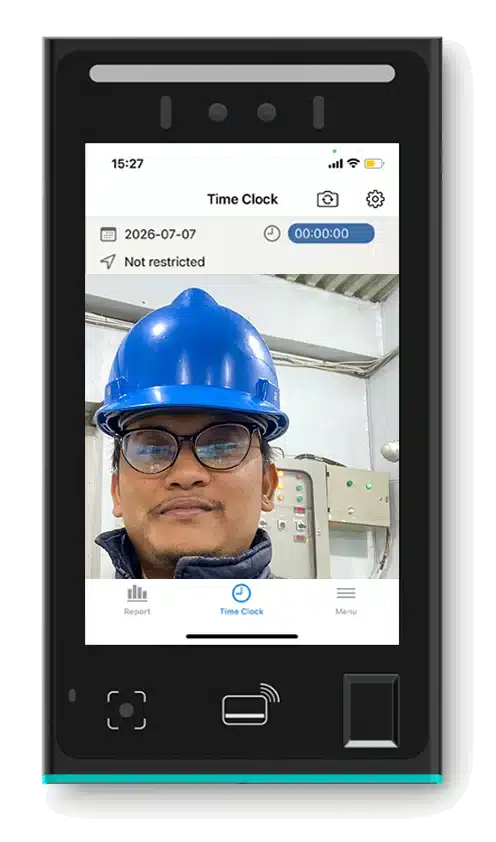
NCheck verifies every check-in by face, fingerprint or iris on the phones and tablets you already have, so there are no attendance machines to buy. Hours go straight into Tally payroll, and the system runs in the cloud from day one or on your own servers in India.
30-day free trial on paid plans · NIST-ranked algorithms







Working hours under the new labour codes.
8 hours a day, 48 a week
The four labour codes replaced 29 older laws and set the normal working limit.
Paid at twice the ordinary rate
Overtime needs the worker's consent and is paid at double the normal wage.
Longer days, fewer of them
With consent and where state rules allow, four 12-hour days or five 9.5-hour days stay within the 48-hour week.
Work schedules can be set to the pattern each site uses, and the Total Work Hours report keeps overtime in its own column, so double-rate hours reach payroll on a separate line.
From check-in to Tally payroll.
Hours come out of NCheck as a Total Work Hours report for each pay period, ready for Tally's Payroll Data Import extension to load as attendance vouchers. The Tally guide shows the column mapping, and QuickBooks Desktop has a guide of its own. Other HR and payroll systems connect through the REST API.
Cloud or on your own servers in India.
NCheck Cloud can have a team checking in the same afternoon. NCheck On-Premises runs the same product on your own servers in India and keeps recording offline when a site's network drops. YRGCARE, a 450-staff healthcare and research organisation in Chennai, runs its own server across seven sites with face, fingerprint and iris.
The DPDP Act and the SPDI Rules.
Until 13 May 2027, biometric data falls under the SPDI Rules, which require written consent before collection, and the DPDP Act's duties apply from that date. NCheck stores an encrypted template and never a photo, and our India DPDP page sets out the timeline and penalties.
NIST-ranked algorithms · 35+ years of biometric R&D · 30,000+ daily users · 1,000+ locations · Why NCheck →
“Before, traditional time & attendance meant a lot of work to synchronise reports. With NCheck we do it with just a few clicks.”

“We are using this software across different locations and it just works. A great fit for small and medium-size organisations.”

Frequently asked questions.
Do we need employee consent under the DPDP Act?
Until 13 May 2027, the SPDI Rules require written consent before biometric data is collected, and electronic consent counts. After that, the DPDP Act allows consent or certain employment purposes under Section 7, though consent with a clear notice remains the safe route. This is general guidance, not legal advice.
Is Aadhaar needed to use NCheck?
NCheck doesn't use Aadhaar. Each employee is enrolled from a photo or a fingerprint or iris scan, so no Aadhaar number or authentication is involved.
Can attendance be exported to Tally?
Each pay period's hours export as a CSV that Tally imports as payroll attendance vouchers, with overtime on its own line.
Can NCheck run on servers in India?
NCheck On-Premises installs on your own servers in India, so biometric data stays in the country. NCheck Cloud is hosted outside India, which counts as a transfer abroad under the SPDI Rules.
Verified attendance
for teams across India.
Free for up to 5 employees, with a 30-day trial on paid plans. Prices are in euros.