Touchless check-in in two seconds, no queue at the gate.
Nothing to touch and nothing to carry. A worker looks at the camera and keeps walking, the record is made in under two seconds, and several stations on one account clear a whole shift change before the first machine starts.
Free for up to 5 employees · 30-day trial on paid plans · no card needed





What does the line at the gate actually cost?
Everyone in the queue is being paid to stand still, twice a day, every working day. It is one of the few wastes you can measure exactly.
Your gate at shift change
Your yearly saving
after using NCheck
An estimate, not a promise. It counts paid time spent in line, not lost production.
The line moves at walking pace.
A worker approaches the station, looks at it, and carries on walking. Verification is sub-second and nothing is touched, so the limit on throughput is how fast people walk past rather than how fast the device thinks. Where a crew arrives together in one vehicle, group check-in recognises several enrolled people from a single photograph, so a van does not become a queue. Where two hundred people arrive in the same five minutes, the answer is two or three stations on the same account rather than one faster machine — and a station is a tablet, so parallelism is cheap. If a face is not recognised, the person uses a PIN or a QR code and the line does not stop while anybody investigates.
What it does not do: it does not widen the gate. If the bottleneck is a single turnstile that one body fits through at a time, the check-in will no longer be the constraint, but the turnstile still will be.
Four minutes of queue a shift is about an hour a month. At €6 an hour that is four times what NCheck Standard costs that worker.
Standard is €1.50 per employee per month with unlimited employees. Extra stations are a €95 one-time Admin licence per device — there is no per-lane or per-reader charge. Liveness detection, GPS, geofencing, offline mode and access control are in the plan price — not add-ons.
What a shift-change queue costs a plant.
Shift change is a burst, not a flow. Two hundred people do not arrive across an hour; they arrive in the eight minutes after the bus and the car park empty. A single reader is a serial device, so the burst becomes a line, and the line is paid time.
The second cost is the one that does not show up in the calculator above: the shift cannot start until the people are in. If the handover slips four minutes at each change, that is production time at the end of the line, which on most plants is worth considerably more per minute than the wages of the people waiting.
What usually happens next is that the rule quietly relaxes. One person swipes a handful of cards, or a supervisor writes the arrivals on paper and enters them afterwards. That restores the flow and destroys the record — the plant now has a queue problem and an accuracy problem, and the second one is harder to see.
What it does not do: faster check-in will not recover handover time that is lost to briefing, PPE or walking distance. It removes the part of the delay that is queueing.
Can one station serve a whole shift arriving at once?
For a few dozen people, comfortably. For hundreds arriving in one burst, use two or three stations in parallel — that is cheaper than expecting one device to absorb it.
How many stations do we need for 500 workers?
It depends on how tight the arrival window is rather than the headcount. Tell us the window and the gate layout and we will work it through with you rather than guess.
What happens if a face is not recognised in the queue?
The worker falls back to a PIN or QR code and keeps moving. The line does not stop.
Touchless check-in in two seconds: stations, group check-in, no cards.
A station is any device running the Admin app at a fixed point: a tablet on a bracket, a Windows machine with a webcam, an IP camera above a turnstile. It holds the templates it needs locally, so matching does not wait on a network round trip and the gate keeps working if the link drops.
Group check-in is the feature that suits crews. Several enrolled people are recognised from one photograph, which matches how construction and agricultural labour actually arrives — ten people in a vehicle, not ten people in a line. Subcontractors are enrolled at the gate from a single photo without entering your HR system.
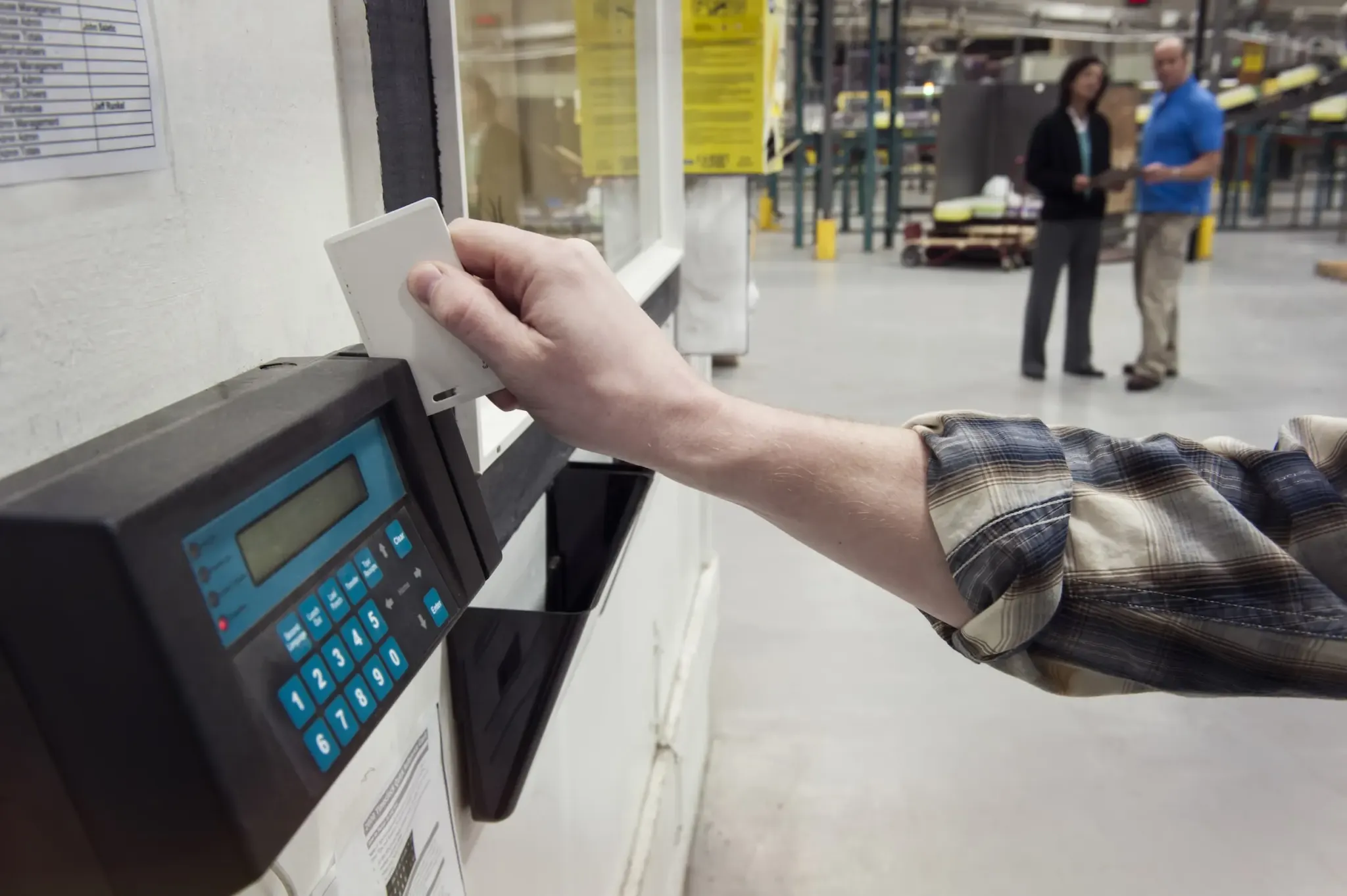
Nothing is touched at any point, which removes the second hidden queue: the one caused by people wiping a fingerprint reader, retrying a failed read with a dirty or wet finger, or hunting for a card in work gloves. Gloves, dust and safety glasses are irrelevant to a face check, which is why this suits sites where hands are rarely clean.
What it does not do: group check-in needs people to be enrolled and reasonably visible in the frame. It is not a way to count a crowd nobody has enrolled.
Can subcontractor crews be grouped?
Yes — enrol them at the gate from one photo, then group check-in handles the whole crew arriving together.
What about gloves, dust and protective equipment?
None of them matter to a face check. There is no contact, so gloves are irrelevant, and the algorithms handle dust, changing light, beards and glasses.
Do we need to buy terminals?
No — a tablet, a webcam PC or an existing IP camera works. The only cost is the €95 one-time Admin licence per device.
Do we need a biometric attendance machine?
No. The hardware you already own is almost always enough, and this is the question that stalls more attendance projects than any other. The Attend app is free with unlimited installs on Windows, Android and iOS, so a phone or an existing PC becomes a check-in point at no cost. For a shared gate, the Admin app turns a tablet, a webcam machine or an IP camera into a station for a one-time €95 licence per device. There is no proprietary terminal to specify, quote, wire and wait for, and nothing that becomes obsolete when a supplier changes its range. If a gate genuinely has no device, the purchase is a consumer tablet and a bracket. See biometric attendance machines and supported devices.
Contactless where hygiene matters: masks, gloves, wards and kitchens.
In a hospital, a food plant or a commercial kitchen, a shared fingerprint reader is a surface that several hundred people touch between hand-washes. That is a real objection, and it is usually what prompts the move rather than the queue.
A face check requires no contact at all. Face mask detection handles the related problem in the same frame: in environments where a mask is required, the check-in can confirm it is on, exactly as a construction gate confirms a hard hat. Check-in works with surgical masks, so staff do not have to remove one to clock in — which was the practical failure of face systems in clinical settings before.
The same property helps anywhere hands are dirty, wet or gloved: cold stores, loading bays, workshops, paint lines. The reason is mundane but it is usually the deciding one.
What it does not do: face mask detection confirms a mask is present at check-in. It does not assess the type of mask or whether it is correctly fitted.
Is biometric check-in hygienic for hospital staff?
Yes — nothing is touched. That is the main reason clinical sites move away from shared fingerprint readers.
Does it work with surgical masks?
Yes. Staff do not need to remove a mask to check in, and mask detection can confirm one is being worn where that is the rule.
Is it suitable for a food production environment?
Yes — no contact, works with gloves and hairnets, and the station can be sited outside the clean area.
Three ways to clear a shift change.
| One card reader | One fingerprint terminal | NCheck | |
|---|---|---|---|
| Throughput limit | One swipe at a time | One finger at a time, plus retries | Walking pace |
| Contact | The card and the reader | Every person, same surface | None |
| Gloves and wet hands | Fumbling | Failed reads | Irrelevant |
| Crews arriving together | One at a time | One at a time | Group check-in from one photo |
| Adding capacity | Another reader and cabling | Another terminal | Another tablet on the same account |
| On a failed read | Try again | Try again, then a supervisor | PIN or QR, line keeps moving |
| What the record proves | A card was there | A finger was there | A verified living person was there |
Who this is for — and who it is not.
Best for
- Plant and operations managers whose shift handover slips at every change
- Hospitals, food plants and kitchens where a shared touch surface is the objection
- Sites with crews arriving together in vehicles rather than one at a time
Not for
- Small offices with no queue to clear
| If this is your situation | The setup is |
|---|---|
| 200 people in an eight-minute window | Two or three stations in parallel on one account |
| Crews arriving by vehicle | Group check-in from a single photograph |
| A single turnstile that cannot widen | A station before the turnstile, so check-in is not the constraint |
| Clinical or food-handling areas | Touchless station sited outside the clean area, mask detection on |
| A gate with no network | Offline stations; they record locally and sync later |
"Before, traditional time & attendance meant a lot of work to synchronise reports. With NCheck we do it with just a few clicks."
What is touchless check-in?
Touchless check-in records attendance without the worker touching any shared surface or presenting a physical object. A camera recognises the person, confirms with liveness detection that it is a living face rather than a photograph, and writes the record. It became common in healthcare and food production for hygiene reasons, but the operational argument is throughput: because nothing is handed over, inserted or pressed, a line moves at the speed people walk rather than the speed a device can be operated. It is sometimes called contactless attendance or no-touch clock-in. The practical requirements are a camera at a sensible height, reasonable lighting, and enrolment of everyone who will use it.
What to check before you commit.
- Was the speed you were shown measured on one person, or on a line of twenty?
- What does adding a second check-in point cost — a licence, or an installation?
- What happens when someone is not recognised, and does the line stop while it is sorted out?
- Can a crew arriving in one vehicle be checked in together?
- Does the station keep working when the network is down?
- Does anything have to be touched, by anyone, at any point?
- Will it work with the gloves, masks and headwear your people actually wear?
- Is the queue the real constraint, or is it the gate itself?
Before you ask us.
How fast is a single check-in, really?
Matching is sub-second; the person-to-person rate at a station is governed by walking pace. We would rather you timed it in a demo than took a number from a page.
Can we put a station outside?
Under shelter, yes. Direct low sun into the lens is a siting problem on any camera — mount it accordingly.
Does every person need enrolling first?
Yes, once, from a photograph. A supervisor can do it on the same tablet in under a minute per person.
Can the same station do access control?
Yes — it can open a turnstile or barrier on a verified check-in. See door control without new wiring.
What if the shift changes at 2am with no supervisor?
Nothing changes. Stations do not need anyone to operate them, and offline mode covers an unattended gate on a poor link.
Do we need Premium for any of this?
No. Face check-in, group devices and work schedules are available from the Free plan; unlimited employees start at Standard.
Can we run two shifts through two different gates?
Yes — several stations across several gates all report to one account and one timesheet.
Keep reading.
Shared and group devices
One station, a whole crew, one photograph.
Work schedules
Shifts, handovers and overnight pairing.
Face recognition attendance
How the check-in itself works.
Face mask detection
The same frame, one more check.
Healthcare
Wards, hygiene and shift patterns.
Shifts and time zones
Handovers that cross midnight and borders.
Let them look and keep walking.
Free for up to 5 employees. 30-day free trial on every paid plan — bring your worst shift change.
Last reviewed: October 2026. Templates, not photos; deleted on request; on-premises keeps everything inside your network. Details on the security and compliance page.