Biometric attendance system in the UAE and Saudi Arabia.
Attendance built around Gulf working hours.
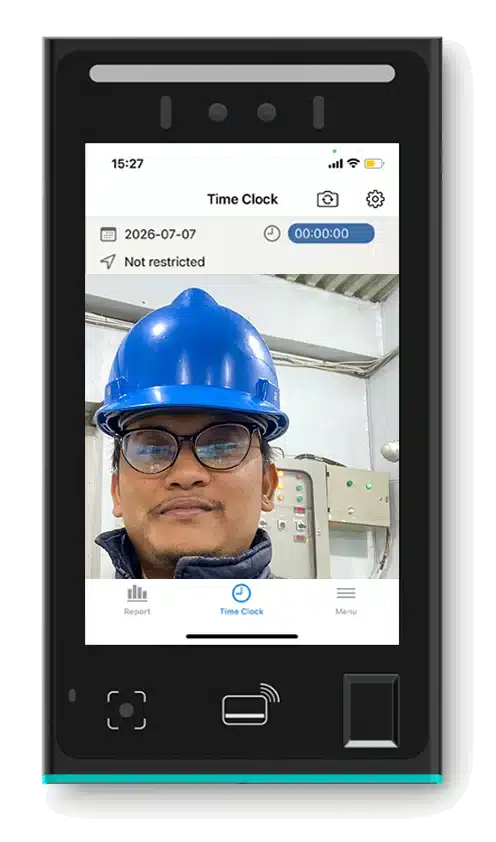
NCheck verifies each check-in by face, fingerprint or iris and turns it into a timesheet payroll can use, on the phones and tablets your teams already carry or a rugged terminal at the site gate. Schedules follow local working rules, and biometric data can stay on servers in the region.
30-day free trial on paid plans · NIST-ranked algorithms





Working hours the system has to follow.
8 a day, 48 a week
The same private-sector limit applies in the UAE and Saudi Arabia.
A shorter working day
In the UAE, two hours shorter for all private-sector staff. In Saudi Arabia, up to 6 hours a day or 36 a week for Muslim employees.
Midday outdoor break
Outdoor work stops from 12:30 to 3pm in the UAE and from 12 to 3pm in Saudi Arabia.
Ramadan hours can run as their own schedule in NCheck, and on Standard the midday break can be built into summer shifts, so each day's check-ins are measured against the right working day.
Two examples from the region.
The main biometric attendance system page explains how enrolment and check-in work. Here is how they play out on two Gulf sites.
A construction site
A contractor puts a tablet at the site gate, and 300 workers check in by face, which reads reliably where dusty or worn fingerprints don't. Summer shifts include the midday break, and the timesheet shows when each crew went back out. If the site loses signal, check-ins are stored and sync later.
A hotel
Each outlet, from the restaurant to the spa, is set up as a separate location with its own schedules. Staff check in by face on a tablet at the staff entrance, and head office sees every outlet's hours in one report.
PDPL and where the data is held.
Both countries treat biometric data as sensitive personal data. Saudi employers usually rely on explicit consent and must carry out an impact assessment, while UAE employers can also rely on employment-law obligations, and companies in the DIFC and ADGM follow their own rules. Our GCC compliance page covers the detail.
If you'd rather buy through a local integrator, NCheck works with partners in more than 20 countries and passes enquiries to active partners in your region where it can.
NIST-ranked algorithms · 35+ years of biometric R&D · 30,000+ daily users · 1,000+ locations · Why NCheck →
“Before, traditional time & attendance meant a lot of work to synchronise reports. With NCheck we do it with just a few clicks.”

“We are using this software across different locations and it just works. A great fit for small and medium-size organisations.”

Frequently asked questions.
Is biometric attendance allowed under the PDPL?
It is allowed in both countries, with conditions. Employers need a lawful basis, usually explicit consent in Saudi Arabia, should tell staff what is collected and why, and should keep a non-biometric option for anyone who declines. This is general guidance, not legal advice.
Can the data stay in the Kingdom?
With NCheck On-Premises, everything runs on your own servers in Saudi Arabia or the UAE. NCheck Cloud is hosted outside the region, which counts as a transfer abroad, and Saudi Arabia has consulted on a rule that would require personal data to be stored in the Kingdom.
Does it work with local payroll systems?
Timesheets export to Excel and CSV for any payroll system, and the REST API connects HR and payroll platforms directly.
Is there an Arabic interface?
Language needs vary between sites, so speak to the team about specific requests, including Arabic for the apps or the admin panel.
Verified attendance
for Gulf teams.
Free for up to 5 employees, with a 30-day trial on paid plans. Prices are in euros.